
Publications & Insights

Accellency publishes regular in-depth and short insight pieces, looking at the hot topics and major challenges facing investment funds, private and listed companies.

You can read them here.

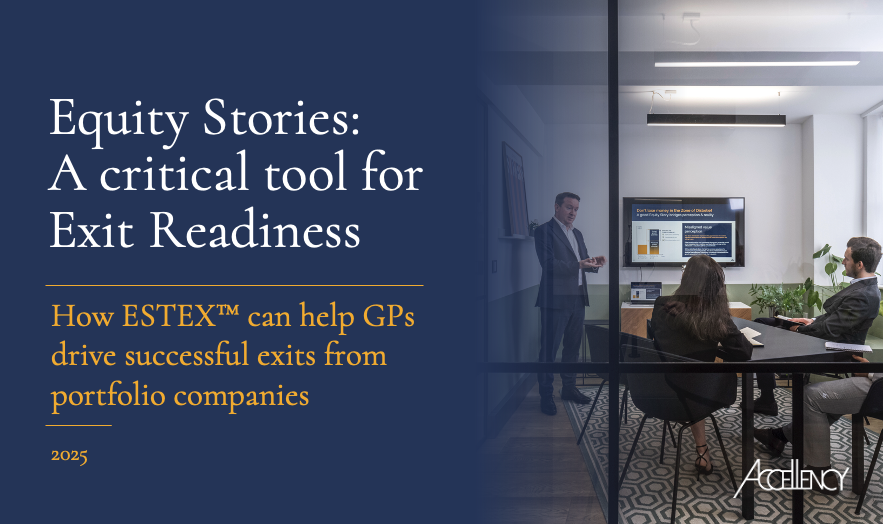
Why is an equity story critical to exit readiness?

An equity story is critical to exit readiness because value creation does not automatically translate into value recognition at exit. When a portfolio company’s fundamentals have improved but investor perception has not, a gap opens between its true growth potential and the value buyers recognise, which Accellency calls the “Zone of Disbelief”. A strong equity story closes that gap, bridging how a business has been transformed and how buyers perceive its future value, as lengthening holding periods put GPs under pressure to convert portfolio value into successful exits.

Why do mature consumer brands trade at a discount and how do you fix it?

In mature sectors like consumer staples, equity stories too often recycle tired narratives, while what really drives valuations is how a business frames growth in a changing landscape. A mature B2C brand is usually undervalued because of its narrative, not its sector, and three shifts separate the brands that re-rate from those that stay cheap: escaping the squeezed middle, turning loyalty into community multiples, and innovating in how the business makes money.

What are the most frequent mistakes made at an AGM and how to avoid them?

An AGM’s highest-value use is as a marketing opportunity to engage LPs, convert prospects and build future vintages, yet funds forfeit that value through five recurring mistakes: running the AGM as a reporting exercise, turning it into a monologue, leaving no time for peer networking, failing to prepare speakers, and underestimating the master of ceremonies. Each is avoidable with forward-looking content, a dialogue format, built-in networking, rehearsed speakers and a briefed master of ceremonies.

How does thought leadership help GPs raise capital in a crowded market?

Thought leadership helps GPs raise capital by building credibility with LPs long before fundraising begins, closing the gap between a fund having genuine merit and that merit being seen and trusted by overwhelmed LPs. Thought leadership is the publication of original insights, research or market perspectives that demonstrate a GP’s expertise. The content that moves the needle is research-led and story-driven, built on original data, a clear point of view and strong design.

Why are GPs turning to full or targeted outsourcing of DDQ & PPM production?

GPs outsource DDQ and PPM production because doing it in-house overloads a stretched IR team, recycles the last vintage’s materials and underestimates rising LP expectations. A DDQ (due diligence questionnaire) and PPM (private placement memorandum) are the core documents LPs use to evaluate a fund, so their quality shapes a GP’s credibility. Outsourcing lets the IR team stay focused on investors while experts produce documents that meet current LP standards.

What are the biggest investor relations challenges for listed companies?

The biggest investor relations challenges for listed companies range from avoiding errors in an earnings release and communicating bad news well to responding to pressure on the share price. Since 2005, more than 12,000 companies have delisted in Europe, leaving markets more concentrated and competition for investor attention more intense. As a result, investor relations has become increasingly strategic, where a seemingly minor issue can turn into a value trap or knock a carefully built equity story off course.

Why do private tech companies need investor relations?

Private tech companies need investor relations because without it a company risks failed capital transactions, value impairment and, ultimately, operational failure. In the first half of 2026, venture capital reached fewer companies in larger cheques, so capital has concentrated in AI and investors have grown more selective. As a result, a company’s ability to articulate a credible, defensible equity story increasingly determines both its access to capital and its value at exit.

How can an Equity Story increase your valuation?

An equity story increases valuation by lifting both halves of the multiple: the sector a company is judged in and its growth trajectory, since a valuation multiple is the product of the two. An equity story is the financial narrative that shapes how investors value a business, and as markets shift and higher-valued sectors emerge, it must be repositioned to keep a company in the right sector with a credible growth story, which is critical whenever capital is being raised or value is realised.

Any questions left?

Accellency has delivered 200+ mandates with a Net Promoter Score exceeding 80, for clients including Ardian, KKR, TowerBrook, Eurazeo, CVC, Tikehau, Astorg, Bridgepoint, Edmond de Rothschild, AXA, Jeito, Crédit Agricole, OVHcloud, Adevinta, Carmila, Klépierre, Younited and more. Mandates cover equity stories, go-to-market positioning, IPOs, roadshow preparation, IR advisory, AGMs and white papers.

Accellency has in-house expertise across eight asset classes: private equity, private credit, real estate, infrastructure, secondaries, venture and growth, impact and hedge funds.

Yes. Accellency has a successful track record running the equity streams of major IPOs in Europe and the US, including OVHcloud and Global Blue.

News

News & Updates

Our news section provides insights into recent developments, company achievements and industry trends that shape our business and the markets we serve. Stay informed about our latest activities and strategic initiatives here.

Accellency attended IPEM Global 2026, held from September 8th to 10th, at the Palais des Congrès de Paris. It was a great opportunity to reconnect with familiar faces and hear how leading private equity practitioners are thinking about exit readiness today. One panel in particular stood out, centered on the theme of equity story & exit […]

…

Accellency was honoured to attend the annual Gala dinner of the Fondation des Femmes, a particularly special edition this year marking ten years of action and mobilisation for women’s rights. This fundraising evening was filled with energy and good spirits, bringing together clients, partners and long-time supporters around a cause we deeply believe in. A […]

…

The private equity exit market is more selective than it has been in years. Buyers are demanding, financing conditions remain tight and exit windows open and close with little warning. In this environment, the question is no longer simply whether a portfolio company is a good business. The question is whether it is ready to […]

…